Showing posts with label Greek. Show all posts

Saturday, 2 October 2021

Greek Pastitsada

This rich and hearty chicken in tomato sauce served over spaghetti has became a real favourite of late. 

It's not authentic in recipe I'm sure, but is absolutely my interpretation of this Greek classic that I've only ever enjoyed on the islands of Corfu and Kefalonia - the Ionian Islands. 

Aside from frying off the chicken, I make this in the slow cooker too and the slow cooking really improves the depth of flavour and makes the house smell great too - win, win. The below serves four.


Here's how:

  • x6 Chicken Thighs
  • x1 tin chopped tomatoes
  • x1 onion
  • 2 tbsp capers
  • Handful green olives
  • x2 garlic cloves
  • 1/2 tsp cinnamon
  • 2tbsp tomato puree
  • 1 glass of red wine (I use whatever is open, and worst case white wine works too)
  • Fresh rosemary needles 
  • Chicken Stock Cube or Stock Pot
  • Salt and black pepper
  • Spaghetti
Firstly season the chicken well and then fry off in a pan with a little hot oil until the skin side is crisp and brown then add to the slow cooker.

Dice the onion and mince the garlic and add to the slow cooker. 

Add the tinned tomatoes, tomato puree, red wine, capers, cinnamon and add to the slow cooker. 

Slice the green olives and add with the chicken stock cube (but no excess liquid to make up stock). 

Season the dish then stir to mix everything together, add the Rosemary needles then pop onto to cook for 2 hours on the high setting or four hours on the low setting. 

When getting ready to serve, cook the spaghetti or any pasta you prefer to al dente. 

I like to remove the chicken thighs, and set aside at this point. Then before draining the pasta, I  add 1 tbsp of the cooking water to the Pastitsada dish to loosen, then add the drained pasta directly into the Pastitsada sauce and mix well until every strand is well coated. 

Then I dish up the pasta first, and add a piece of chicken (or two for hungry people) on top of the pasta. Enjoy!

Other Greek inspired dishes you may enjoy:

Friday, 24 July 2020

Prawn Saganaki

This is a dish that transports me instantly to the Greek Isles, particularly Corfu and is something I've been making for a decade. In fact I shared this recipe for it back in 2013 but I have updated it a little since then.

I serve this with fresh, chunky bread to dip in the unctuous sauce with oozing melty feta and a side salad.

You can use any prawns, but the shell on kind are the best as they add flavour to the sauce; just prepare a finger bowl with water and lemon and serve with serviettes or kitchen paper!

Prawn Saganaki

Prawn Saganaki


Here's how:

  • 400g king prawns (shell on)
  • 1 red onion
  • 2 cloves garlic
  • 2 tbsp capers 
  • 6 tomatoes (you can use a tin too)
  • 1 tsp honey
  • 1 tsp dried oregano
  • 3 tbsp dry white wine
  • Salt
  • Black pepper
  • 1 block of feta (200g)
  • Olive oil
  • A few basil leaves to garnish

Pre-heat the oven to 180 degrees and place an ovenproof pan on the hob on a medium heat with a generous drizzle of olive oil. 

Finely dice the onion and mince the garlic and add to the pan.

Roughly chop the tomatoes and add to the pan with the white wine, oregano, honey and a good pinch each of salt and pepper. Cook down for at least fifteen minutes or until the tomatoes have broken down and become a little mushy. 

Now remove about half of the sauce and place into a blender or Nutribullet and blitz to a puree then return to the pan and mix the two halves together. 

Break the feta into bite sized pieces and scatter two thirds of it all over the dish and bake in the oven for 20 minutes then remove from the oven and place onto the hob.

Now arrange the prawns on top, pushing each one into the sauce a little. Complete by taking the leftover feta and crumbling into small bits all over the prawns. 

Return to the oven for 12 minutes, or until the prawns are cooked through and have turned a glorious shade of pink. Take care not to over-cook or you'll end up with rubbery prawns. 

When you remove from the oven leave to stand for five minutes before serving and garnish with a few basil leaves. Enjoy!

As you may know I'm a little obsessed with Greek food and here are a few other recipes you may enjoy too:


Sunday, 3 May 2020

Lamb Kleftiko

Lamb Kleftiko is a joyous dish, it takes just a little effort to make something truly spectacular and utterly delicious; you just have to be prepared to have the oven on all day. 

The marinade that is rubbed into the meat, helps to give a beautiful flavour, and cooking low and slow in the oven, means the meat will literally fall or pull apart at the slightest touch of a fork.

I make the lamb on a bed of potatoes and tomatoes with a few other seasonings, and then served with a Greek Salad and some Tzatziki.

I've used the cheaper cut of half a shoulder of lamb here, but many recipes call for the more expensive leg; which would be great if you are feeding a bigger crowd.

The below serves 4-5

Lamb Kleftiko


Here's how:

1/2 shoulder of lamb

For the meat rub/marinade:

  • 3 tbsp olive oil
  • 1 tsp cinnamon
  • 1 tsp dried oregano
  • 1 tsp dried rosemary
  • 1 tsp salt
  • 1 tsp black pepper
  • 1 tbsp capers
  • 4-5 cloves garlic
  • Juice of 1 lemon


The vegetable base:

  • 6 potatoes
  • 4 tomatoes
  • 2 tbsp Kalamata or other black olives
  • 4-5 garlic cloves
  • 1 lemon
  • 1 large red onion
  • Handful bay leafs
  • Pinch salt
  • Pinch black pepper
  • 1 glass white wine
  • 1 glass water

You will also need:

  • Grease proof/baking paper or tin foil
  • Large roasting tin or casserole dish
  • 1/2 glass water
  • Small corner of feta cheese (optional)


Firstly make the meat rub by either placing all of the ingredients into a Nutribullet or blender, or simply pulsing with a pestle and mortar. You should get a dark brown paste.

Take the lamb shoulder and rub it all over with the paste using either your hands or the back of a spoon. Make sure every piece of lamb has a flavourful coating and leave to stand for an hour. 

At this point you can pre-heat the oven to a low 160 degrees.

Now get a large roasting tin or dish, and firstly cover with lots of excess with a sheet of grease proof paper or tin foil length-ways. Now do the same width-ways so you have one piece over another; so once everything is in the dish, you can cover it up well and loosely.

In the meantime you can prepare the vegetables. Firstly peel the potatoes and cut into large wedges; if you cut them too small, they may turn to mush in the long cooking process. Scatter them all over in the roasting tin.

For the red onion, peel it and cut into wedges and scatter about. For the garlic you can either peel or leave in the skins and scatter all over. Throw in the olives (as I have two small girls, I tend to remove the stones first and throw them in). Now cut the lemon into quarters and add to the dish. Season at this point with salt and pepper.

The vegetable base for the Kleftiko


Now you can place the lamb shoulder on top of the vegetables. At this point pour over the dish a full glass of white wine (any open bottle will do it) and then re-fill with water from the tap and pour over this too. 

Lamb Kleftiko before it is wrapped and popped into the oven


Now is the wrapping process; you want it sealed up, but not too tightly. Grease proof paper lends itself really well to this. I've tried to show pictures of how I do this; you can also use kitchen string, but I find you can fold and scrunch it easy enough. So firstly take the length ways piece of paper, fold each end over towards each other, and then take the corners and kind of knot or scrunch around each other so the dish is loosely covered. 

How to wrap the first layer of paper around the Kleftiko

The second bit is easier, you just fold over and then to seal, I pour over about half a glass more water, which stops the liquid inside escaping and helps to keep the lamb moist and tender.

Fully wrapped Kleftiko with a little water over to keep it sealed


Now place into the oven and cook for a minimum of 5 hours; but for perfect, pull-apart at the touch lamb, cook for 7 hours. Remove from the oven, and serve at the table with your choice of accompaniments and unwrap at the table for the big reveal. As an optional extra, you could crumble over a little feta cheese before serving for one final Greek flourish. Enjoy!

Lamb Kleftiko

If you love Greek dishes like us, you may enjoy some of the below recipes:

Moussaka
Chicken Souvlaki
Prawn Saganaki
Pastitsio - The Greek Lasagna
Briam
Gemistes - Greek Stuffed Tomatoes
Feta and Spinach Open Tart
Greek Chicken Traybake
Beef Stamna 
Spanakopita - Greek Cheese and Spinach Pie
Soutzoukakia - Greek Meatball Bake
Greek Chicken One Pot


Tuesday, 30 July 2019

Spanakopita - Greek Cheese & Spinach Pie

This is probably one of the most comfortingly familiar dishes for on the go that immediately transports me to Corfu and two long, hot summers spent a few years back now. You’ll be hard pushed to find a bakery, patisserie or even supermarket on the Greek islands that doesn’t sell a version of the ‘cheese pie’.

I’ve played around with this dish a LOT over the years, and whilst you can add things like sautéed onions and garlic into the cheesy mix, as well as herbs like dill, mint or parsley, this simplified version below is the one that I prefer and that goes down well with adults and kids alike. It is also quicker to prepare, win, win.

You can serve this as an epic vegetarian main course, but I like to serve it alongside a host of other Greek dishes. It is also good cold, and makes for a really, great picnic dish – I take it along whole, and cut it into about 8 pieces when we find our picnic spot. 

Spanakopita - Greek Cheese & Spinach Pie


Here’s how:
  • 1/2 pack filo pastry
  • Olive oil spray (you can also use a pastry brush and some poured olive oil)
  • 200g Feta cheese (do not use ‘Greek salad cheese’ it is not good!)
  • 150g Ricotta
  • 25g Cheddar (or other hard cheese)
  • 250g spinach leaves
  • 2 eggs
  • Fresh nutmeg
  • Black pepper

Firstly pre-heat the oven to 180 degrees and use a generous amount of olive oil in a small-medium pie dish and brush all over to prevent any sticking.

Fill and boil the kettle and place the spinach leaves in a colander. Pour over enough freshly boiled water over the spinach leaves to just gently wilt and leave to drip in the sink.

Now to prepare the cheese mixture. Place the Feta into a mixing bowl and use a fork to roughly mash up a little bit. Now add the Ricotta and grate in the Cheddar. Season generously with black pepper – I omit from adding salt here as Feta tends to be quite salty, but add a pinch if you wish. Mix together roughly.

Now crack in the two eggs, which will enrich this mixture – and which is a very much Greek method of thickening things. Mix well and then grate over a really generous amount of the nutmeg – you want to be able to taste this in the final dish, so don’t be shy.

For the spinach, use a clean tea towel or some kitchen paper to really squeeze the excess liquid out of the wet leaves – try to get them as dry as possible to prevent any soggy bottom situations or from the pie being too wet. Once satisfied add to the cheese and egg mixture and stir it all until it is combined well and set aside.

Now it’s time to layer up the pie. Firstly add one whole sheet of filo over the pie dish long ways, and use your hands to gently press down into the base of the dish, so the excess filo pastry is hanging over the side of the dish. Be as gentle as possible here, as filo is incredibly delicate.

Now use the olive oil spray and spray all over the pastry (or use a pastry brush to gently coat) and then place another sheet over the pastry the width ways this time, repeating the process with pressing down, and then spraying with the oil.

Do one more layer long ways, and then you can spoon in the cheese and spinach mixture. Try to distribute it as evenly as you can. Once satisfied, take the excess pastry and layer it over the top of the pie, spraying any dry bits with the olive oil spray. (I appreciate this sounds like a lot of oil – but if you don’t follow this, the final pie can be really dry, and less appetising).

Take one final sheet of filo pastry, fold it half and place over the top of the pie, gently pressing it down to cover the entire pie. Give a final spray of oil and the pie is ready to bake in the oven. Pop it in for approximately 45 minutes – or until crisp and golden brown. If you have a speedy oven, check after 35 minutes to avoid burning.

Remove from the oven and allow to sit in the dish for five minutes, before using a palette knife to gently go around the outside of the pie, inside the dish, to prevent it sticking, then very carefully use a fish slice or spatula to help you remove the pie from the dish and place onto a wooden board or large plate to serve. Enjoy!

Some other Greek recipes you may enjoy:

Sunday, 6 January 2019

Greek Chicken Traybake

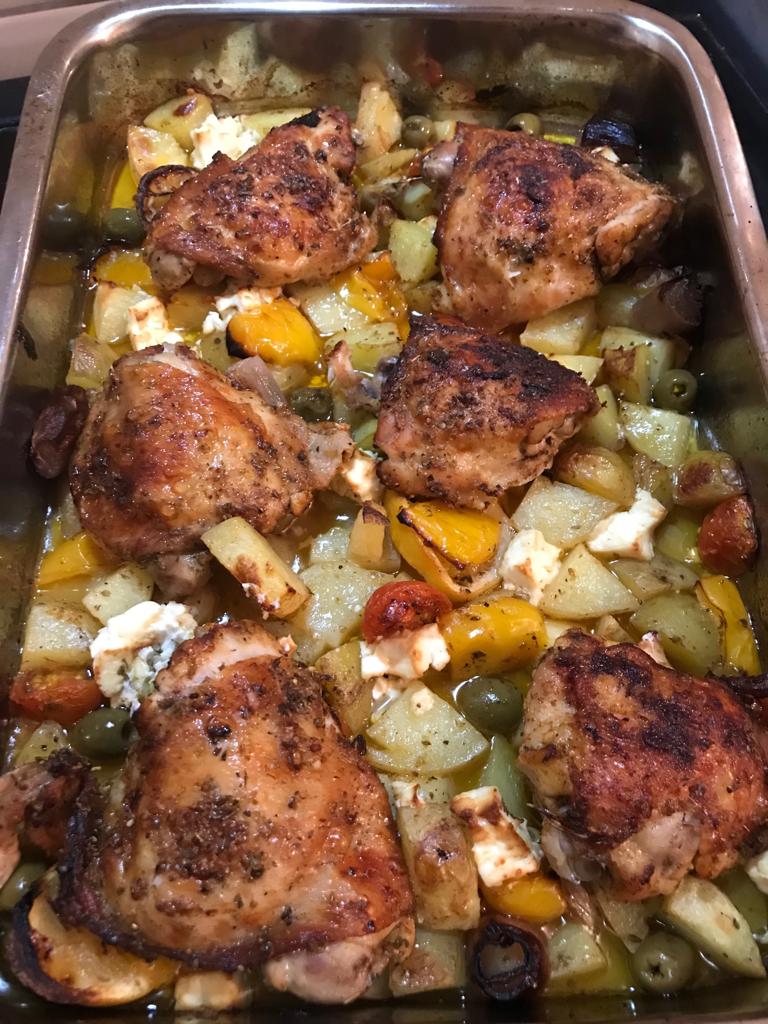
This traybake is simple, fragrant and delicious and aside from chopping up a few vegetables, it can be prepared in minutes and just thrown in the oven all in one which is ideal for a midweek dinner when time is precious and short.

It's good to marinate the chicken for a couple of hours, or overnight for a really lovely flavour, but I've made it straight away too when this (or a version of this dinner) has been thrown together in no time at all. 

If you fancy something different you could drizzle over pesto instead of the marinade or even harissa but the Greek flavours work really well and are my favourite.

If you're trying to cut down on carbs, as so many people tend to be at this time of year, then replace the potatoes with an extra couple of peppers or a large courgette.

The below serves a family of 4.

Greek Chicken Traybake


Here's how:

Chicken marinade:

  1. 6-8 chicken thighs, skin on
  2. 2 tbsp olive oil
  3. 1 tbsp dried oregano
  4. 1 tsp dried cinnamon
  5. 1/2 tsp smoky paprika
  6. 1/2 tsp rosemary
  7. 1 clove garlic
  8. Juice of 1 lemon


Traybake:

  • 2-3 large potatoes
  • 12 cherry tomatoes
  • 1 yellow pepper
  • 3 shallots
  • 3 cloves garlic
  • 1 lemon quartered
  • Handful green olives
  • 60g feta
  • Sea salt and black pepper


Firstly throw the chicken thighs into a food bag and add all of the marinade ingredients - seal and place into the fridge for a couple of hours or overnight if you have time.

When ready to cook, pre-heat the oven to 180 degrees and get out a good sized tray for everything to be assembled into.

Now roughly chop the potatoes into small cubes of approximately 1cm - no need to peel, and then throw into the tray all around.

Now peel and roughly chop the shallots and garlic and do the same. Halve the cherry tomatoes and roughly chop the pepper and add to the tray bake along with the olives and the lemon pieces.

Finally place each chicken thigh or piece on top of the tray bake ingredients, skin side up and once all on, drizzle over any remaining oil over the rest of the ingredients, season generously and place into the oven for 30 minutes. 

Greek Chicken Traybake


Roughly chop the feta or crumble it over the traybake, not on the chicken but on the other bits so it's evenly distributed and return to the oven for a further fifteen minutes or until the chicken is cooked through and golden brown. 

If the potatoes are not cooked enough for your liking, remove the chicken and place on a plate, skin side down, to rest and allow the juices to distribute in the chicken, and return the tray to the oven for a further 10-15 minutes.

Serve with a greed salad, tzatziki and pitta bread for a really delicious midweek meal.

Thursday, 12 July 2018

Moussaka - our Greek Meat Pie

Mousakka is a fantastic family meal and a great alternative to a cottage or shepherd’s pie but one which is equally devoured by my little ladies. Bridget calls this ‘Greek meat pie’ and her and Beatrice had it at least 7 times on our recent fortnight in Kefalonia – a firm favourite.

I favour the version which seems to be more prevalent in the Ionian Islands (Corfu, Kefalonia, Zakynthos) which has a layer of potato in a creamy white sauce enriched with egg, rather than the more well-known layer of aubergine. If you would rather include aubergine instead, just slice an aubergine into 1cm slices, and dry fry for 30 seconds before layering on top of the meat.

I use beef, which again seems to be the norm in the Ionian Islands, but again in some parts of Greece, Turkey and he Balkans this is more traditionally lamb mince, it’s totally adaptable and down to your own personal preference.

It is very much a Greek cooking method to ‘enrich’ a sauce using a beaten egg, which is done here, but please do ensure you wait until the sauce has completely cooled otherwise your hard work will be reduced to scrambled egg.

You’ll be hard pushed to find a more satisfyingly rich meat sauce than a slow cooked Greek one. Greek food often gets a bad rap in the UK, but I think it’s fantastic and my family certainly agree.If you tried and liked the Patsitsio recipe recently - this is up there with that for delivering on flavour, comfort and pleasing all of the family.

Feeds 4-5 and I serve with salad.


Moussaka - our Greek Meat Pie
Here’s how:
The meat:
  • Drizzle olive oil
  • 500g steak mince
  • 1 red onion
  • 1 clove garlic
  • 1 heaped tsp cinnamon
  • 1 heaped tsp dried oregano
  • 1 pinch salt
  • Black pepper to taste
  • 200ml red wine (I used Chianti as we had a bottle open)
  • 1 tbsp plain flour
  • Handful bay leaves
The topping:
  • 4-5 white potatoes (I used desiree)
  • 50g butter
  • 50g plain flour
  • 300ml whole milk
  • 50g Grana Padana or Kefalotyri if you can get hold of it
  • Nutmeg
I make the white sauce first by melting the butter into a non-stick pan, then slowly adding the flour and mixing the whole time with a wooden spoon to make a roux. Now slowly add the milk, mixing in the roux the whole time, pressing it down until it takes the form of the sauce rather than a big lump. Repeat until all of the milk is added, then add the grated cheese and a little nutmeg and continue cooking and stirring the whole time for a further five minutes until the sauce is thick and glossy. Now set aside away from the heat and allow to fully cool.

For the meat sauce, add a drizzle of olive oil to a pan, and place on a medium heat.

Finely dice the onion and mince the garlic and add to the pan. After a couple of minutes, add the mince, cinnamon and oregano and season generously. (You can leave out the salt if preparing for a small baby.)

Use a wooden spoon to break down the meat so it doesn’t clump together and once browned add the flour and mix well. This will help to thicken the final meat sauce.

Now add the red wine, passata and tomato puree, stir well and cook for 30 minutes until it has reduced down to a thick and unctuous ragu.

While the meat sauce is cooking, peel the potatoes and cut into slices about 1cm thick. Give them a good rinse then pour over boiling water add a pinch of salt and cook for five minutes, then drain.

By now the white sauce should have cooled sufficiently, so beat an egg in a separate bowl and then combine with the white sauce, mix well and it should add an extra glossiness to the sauce.

Once you are satisfied with the meat sauce, remove from the heat and spoon into an oven-proof dish.

Now layer the potatoes over so all of the meat is covered.

Now spoon over the white sauce, using the back of the spoon to spread out evenly and ensure everything has a coating of the sauce. The addition of the egg means this should help the topping to ‘hold’ well so once the dish is complete and you’re ready to dish up, you should be able to slice into neat squares of moussaka.

Scatter over the remaining grated cheese and a smidge more freshly grated nutmeg and this is ready for the oven. Bake for 35-45 minutes or until the topping is golden brown and the cheese is melted.


Moussaka - just out of the oven


Moussaka - a firm family favourite

Remove from the oven and allow to cool for a few minutes before portioning and plating up for the family. I serve with salad and this was enough for my family of four plus a generous portion for the following day’s lunch.

Here’s some of our other favourite Greek dishes:
Prawn Saganaki
Pastitsio
Briam
Gemistes
Feta & Spinach Open Tart
Greek Salad
Greek Chicken One Pot
Souvlaki
Tzatziki
Greek Yoghurt and Honey Baked Cheesecake

Friday, 20 October 2017

Pastitsio - The Greek Lasagna

If you've never had the pleasure before, Pastitsio is often referred to as the 'Greek Lasagna' or 'Pasta Pie'. Instead of the thin lasagna sheets of the Italian variety, tubular pasta is used, and a thicker version of the bechamel sauce sits atop the finished dish. 

For me it evokes some fantastic memories of two summers, and countless holidays spent in Corfu in my twenties - great times, and the beginning of my love affair with Greek food, one of my favourite cuisines that I think is hugely underrated. What's more, this is a hearty, family classic, a crowd pleaser, and is devoured every time I cook it.

For my pastitsio I use the typically Greek method of thickening the bechamel sauce, adding a beaten egg once the sauce is off the heat, as well as Greek yoghurt, it just helps the sauce hold together more firmly once baked. I have used penne here, as I simply had some in the cupboard, but it also works with the more traditional bucatini or rigatoni - any tubular pasta.

Also I like to reduce the meat sauce right down by cooking for at least an hour and a half as a traditional Pastitsio is easily distinguishable by it's definite layers, rather that an oozing meat sauce moving into the layers below. I use a lot less pasta for a family sized Pastitsio than in a traditional dish too as it lightens it up hugely! 

Pastitsio

Pastitsio - Greek Lasagna


The below comfortably serves six.

Here's how:
  • 300g tubular pasta - I use penne 
  • 500g steak or beef mince
  • 1 white onion
  • 2 cloves garlic
  • 3 large tomatoes
  • 250g passata 
  • 2 tbsp tomato puree
  • 1 tbsp cinnamon
  • 1 tsp dried oregano
  • 1 tsp dried thyme
  • 1/2 glass of red wine
  • 1 tbsp olive oil
  • Pinch sea salt
  • Pinch black pepper
For the topping:
  • 2 tbsp butter
  • 2 tbsp plain flour
  • 200ml milk
  • 1 tbsp creme fraiche
  • 2 tbsp Greek yoghurt (plain natural yoghurt will also be fine)
  • Bayleaf
  • 2 tsp black pepper
  • Pinch sea salt
  • 3 tsp nutmeg
  • 100g Reggiano Parmigiano or other hard cheese

First prepare the meat sauce. Begin by finely dicing and mincing the garlic and adding to a heavy bottomed pan with the olive oil to soften and flavour the oil.

Roughly chop the tomatoes and set aside for the minute. 

Once the onion and garlic is softened add the meat to the pan to brown off. You can season with salt and pepper at this point and also add the cinnamon. Use a wooden spatula to break up the meat as it cooks and avoid any clumps. 

Once browned, add the chopped tomatoes and cook for several minutes, then add the passata, tomato puree, red wine, oregano and thyme and mix well. Now leave to cook for at least an hour, or more if you have the time.

The meat sauce for pastitsio


To make the topping sauce, add the butter to a non-stick frying pan and place on a low-medium heat and allow to melt. Add the flour a bit at a time, and use a balloon whisk or just a wooden spoon to mix thoroughly, repeat until all of the flour is added and then slowly add the milk, in the same process, stirring and pressing the floury bits down, till it all becomes one. Once all the milk is added, add the bayleaf and the black pepper and grate over the nutmeg. Be really generous with the nutmeg this is an important, flavour, and with the egg and yoghurt that will be added later, this delicate flavour can get lost if you're too cautious.


Add the grated cheese, retaining just enough to scatter over the top, and stir through, until combined. The sauce should slowly thicken. Whilst still on the heat, stir through the creme fraiche until combined then take off the heat. The sauce should be thick and glossy at this stage. Now add the Greek yoghurt and stir through, which will bring the temperature of the sauce down. Finally beat the egg in a separate bowl and then stir this through the sauce, which will thicken it further. Now set aside while you cook the pasta.

Cook the pasta according to packet instructions and then drain and allow to cool for a few moments, until cool enough to handle. 

In the dish you'll be baking the Pastitsio, arrange one layer of pasta. It's traditional to have all the tubular shapes facing the same way and be in a pattern, as I have done with the penne here.

Layer one - pastitsio

Once that's done, spread over the meat sauce, make sure all the pasta is covered. 

Layer two - the meat sauce - pastitsio

On top of the meat sauce, add the final layer of pasta, again try to organise neatly, as it will hold together nicer when you serve. 

Once the meat topping is completely covered in pasta, pour over the thickened sauce, and use a knife or the back of a spoon to spread over all of the pasta shapes. 

Pastitsio

Add a final grating of nutmeg, scatter over the cheese and a season again. Leave for at least 30 minutes before baking, again, this just helps to hold the final shape.

Pastitsio

Place into a pre-heated oven at 180-200degrees and bake for 35 minutes or until the top is golden brown. Serve with a salad of your choice and enjoy!

Pastitsio

Some other favourite Greek recipes of mine:
Briam (Vegetable Stew)

Friday, 19 August 2016

Greek Chicken One-Pot

This is a gorgeous, quick and easy Greek-inspired chicken one-pot dish that’s packed full of flavour, takes very little time to prepare and goes with an array of different accompaniments, from bread, rice, couscous, and as I have done here: chips and pitta.

I created it, based on my favourite Greek flavourings, and out of necessity for a number of things left in my fridge – new one coming tomorrow, so we’ve been ‘running it down’.

I used a red onion, garlic, two different coloured peppers, mushrooms and tomatoes in this dish – but what really gives it some punch is the salt, pepper and dried oregano coating the chicken has before going into the dish to be fried – a real taste of the Mediterranean for me, just delicious and exactly what I’d been craving having putting up with Instagram snaps from Mykonnos and Athens all week from my brother and his partner.

This is a great food for all of the family too - our toddler Bridget absolutely wolfed it down.

Serve with a Mythos or a lovely Greek wine such as a Robola de Cephalonie – yammas! This serves 3.

Greek Chicken One-Pot

Here’s how:
  • 8 skinless, boneless chicken thighs
  • 1 tablespoon dried oregano
  • 1 tablespoon sea salt
  • 1 tablespoon black pepper
  • 1 red onion
  • 2 cloves garlic
  • 1 tablespoon Greek olive oil
  • 1 orange pepper
  • 1 yellow pepper
  • 100g mushrooms
  • 50g cherry tomatoes
  • 1 tin plum tomatoes or passata
  • 1 teaspoon paprika
  • 50g Kefalotyri (Can use Pecorino Romano)

Firstly pour the olive oil into a cast iron casserole dish and place on the hob, on a low heat, to warm through. Pre-heat the oven to 180°.

Slice the red onion and garlic and add to the pan to slowly soften and flavour the oil.


In the meantime, mix the salt, pepper and oregano and scatter over a plate or bowl, then dip each chicken thigh into the mixture, using a fork to turn and evenly coat.

Once the onions have softened, add the chicken to the pan, keeping on a low heat and sear on each side.


In the meantime, wash your hands after handling the chicken; then slice the peppers and mushrooms and set aside.

Once the chicken is whitened, add the peppers, mushrooms and tomatoes and allow to cook for a couple of minutes. Add the tin of tomatoes and the paprika and stir.


Now cut the Kefalotyri or Pecorino Romano into small cubes and scatter over the dish, place the lid on the casserole dish and then pop into the warm oven for thirty minutes.


Serve with your preferred accompaniments – enjoy.

Friday, 15 January 2016

Skinny Stuffed Peppers

Gemistes or Stuffed Vegetables (peppers in this case) are a mid-week favourite at our house, they are quick and easy to prepare so; perfect for our busy lifestyles.

In my quest of healthier eating and losing weight, I created this 'skinny' version using cauliflower rice instead of my usual basmati, and just a little lean steak mince for some protein and iron.

This recipe makes enough mix for x4 stuffed tomatoes or peppers but if you want to make a bigger batch of the filling, it freezes well.

Each stuffed pepper contains around 250 calories and you can serve with your choice of accompaniments – here I had a side salad, 100g sweet potato fries and 30 feta for a really lovely balanced meal.

I highly recommend also preparing your own low-calorie tzatziki to accompany the gemistes too which you can do by combining 3 tbsp 0% fat natural yoghurt, 50g cucumber (grated), one minced garlic clove and a few mint leaves - 1 tbsp is around 30 calories so it's well worth the effort for a real taste of Greece. 


Skinny Stuffed Peppers


Here's how:

  • 150g lean steak mince
  • 1 onion
  • 1 garlic clove
  • X4 peppers or beef tomatoes (for stuffing)
  • 100g cauliflower
  • Handful fresh mint leaves 
  • 1 tsp oregano
  • 1 tsp cinnamon
  • 1 pepper (any colour)
  • 1 large tomato

Firstly place 10ml coconut oil into a non-stick pan and place onto a gentle heat.

Now finely dice the onion, mince the garlic and place into the pan.

Now cut the rest of the vegetables (barring the cauliflower) into small cubes, of the same sort of size and set aside for the minute.

Either blitz your cauliflower in a blender or if you prefer a slightly coarser, larger texture like myself, use a box grater and simply grate it, leaving to one side.

Once the onions have softened, add the lean steak mince and season with a pinch of black pepper and salt. Use a spatula to move the meat around and prevent it from sticking together.

Once the meat has started to brown add the oregano and cinnamon and stir and then add the tomato, pepper and courgette and allow to fry for a few more minutes.

Skinny Stuffed Peppers

At this point pop the oven on to 180 degrees and prepare the tomatoes or peppers for stuffing. If using peppers, simply slice the top off, and remove the seeds, retaining the top (stalk too) for a lid. If using the tomatoes, gently slice the tops off (also retaining) and then with a sharp knife cut out all of the flesh, leaving just the shell of the tomato behind. Then add a smidge of salt to the inside of each one and turn upside down to draw out a little of the moisture and prevent it from becoming too soggy during cooking.

Back to the meat mix, by now you will be ready to add the cauliflower rice and simply fry with all of the other filling ingredients for around 2 minutes then remove the pan from the heat.

Now finely slice the mint leaves - be generous here as these leaves will give great flavour to the finished dish. Now stir through the meat and vegetable mix.

Now place the peppers or tomatoes into an oven proof dish, and spoon in the filling till each is tightly packed full. Place the lid on top of each and of mot secure, use skewers or cocktail sticks to hold in place during cooking. Now loosely cover with foil and place into the oven for forty minutes.

Skinny Stuffed Peppers

 Allow to rest for a few minutes before serving with your choice of accompaniments. Enjoy!

Tuesday, 22 September 2015

Captivated by Kefalonia

In June my partner Glen and I took our little, then nine month old, daughter Bridget on our first holiday as just the three of us – destination Kefalonia.

If you regularly read this blog, you will know I’m heavily influenced by Greek cuisine in my own cookery – I adore the flavours and I adore the Greek islands too. This was my first trip to Kefalonia and I can safely say it won’t be my last and I jotted down a few things to share, should anyone want any pointers if visiting the island.

We travelled with Olympic and stayed in the resort of Lassi at the charming and quaint Irilena Hotel. The hotel was named for the owner’s daughter, who in her early thirties was regularly seen at the hotel bar – however this was primarily the domain of her fiancé Aggi, and Tasos, both local men from Argostoli. We got on so well with both of these, they were just the friendliest people and my daughter adored both of them as they were constantly making a fuss of her. We would have a tipple in the bar each evening – sometimes until 2am and then Tasos would have to get up and go to work in his 9-5 job too in the town – but you never heard a word of complaint from him.

In terms of the rooms – they are fairly basic and typically Greek to be honest – although kept spotlessly clean and they have everything you could need as a base if you’re not spending too much time in the room. Athina – the owner was around each morning and again made such a fuss of the baby and was always checking did we have enough of everything in the room. She even gave up her own personal room on our last day so we could get Bridget and ourselves showered before our late flight. Nothing was too much at this hotel.

Lassi in general, as we learned, is a purely tourist resort – but this couldn’t take away from its’ charm. With a scattering of tavernas serving all of the local delicacies, such as Kefalonian meat pie, moussaka, stiffado and kleftiko there really was something for everyone. I won’t go through each and every restaurant as we did have good meals everywhere – but some of the restaurants in the resort of note, include Veronika’s, Butler’s House and Nefelli’s. We also had a fabulous night at Zorba’s where traditional dancing took place and the food was fantastic too. 


Feta topped Mushroom 

Kleftori Mushrooms

Beef Stiffado

Moussaka

Feta Saganaki and mix plate

Feta in the oven


We kept our week fairly low key, being as it was warm and we obviously had Bridget in tow. However this didn’t stop us venturing into Argostoli three days of the week. The bustling capital has some fabulous sites and was just an eight euro taxi ride away – I was very excited to see the fishermen selling their wares to local on the harbour-side. Argostoli is full of shops, bars and restaurants and if you were looking for some nightlife this would be the place to find it – on this part of the island at least. 

Argostoli harbour


Mid-way through the holiday we’d booked onto the island tour trip with Etam Travel and this was an absolute highlight. We took in some wonderful sites that are frankly must-see; Myrtos beach is that beautifully picturesque bay that is seen on postcards, in films and the like, and the view is truly spectacular. We were rowed through the Melissani Cave, a natural wonder, and traipsed down the Cave Drogarati too – a strangely eerie experience where you manage to feel incredibly cool, despite the outside temperature being over 90 degrees. Another highlight was visiting and tasting a selection of wines at the Robola Wine Co-Operative – where we also bought four bottles to bring home. We also visited the Monastery of St Gerassimos which was a moving experience – the people of Kefalonia call on this saint when in need even to this day and it brings back what a deeply religious place Greece can be. During the island tour we stopped for a couple of hours for lunch at Aghia Efimia a little fishing village where we enjoyed a lovely lunch and yet more beautiful views.


Myrtos Bay

Mellisani Cave

At Myrtos 

Aghia Efimia

I celebrated my 31st birthday whilst on the island and we took this opportunity to visit Lixouri – you take the ferry from Argostolli and on such a warm day, this was a pleasure in itself. We visited a little beach (I’m afraid I don’t recall the name) and had some cold drinks after about a thirty minute walk to find it. We then had a beautiful lunch in the main square of Lixouri – a platter of Greek specialities including Kefalonian meat pie, moussaka, dolmades, stuffed tomato, giant beans and a selection of dips – heavenly. 

Greek mix plate


My favourite experience of the week though has to be one we stumbled upon thanks to a female taxi driver we met – once again an example of how friendly and helpful a people the Kefalonians are. We asked to go to a different beach and Maria recommended one in Svoronata – she said it would be perfect as the water is shallow there for baby and slightly cooler as a result – she also told us the taverna there was so good that her family went there on special occasions, which we took with a pinch of salt wondering if she was recommending a friend or family’s business.

The beach was Avithos, and the restaurant To Enetiko – our best meal of the week by far. The beach was small and less busy than Costa Costa where we’d spent most of the week, it was perfect for Bridget – especially when she had a couple of naps. Peaceful and tranquil would be accurate descriptions. The food at the taverna was exceptional and makes my mouth water even thinking about it. We were greeted with home baked bread, olives and a tapenade and ordered a couple of Mythos beers to quench the thirst built up in the gorgeous sunshine. We shared the squid starter and it was the freshest, most tender, and flavourful version I have ever had – it literally tasted of the sea, in a good way. Glen had the special of the day, a slow-cooked rabbit dish in a tomato stew and I had my favourite prawn saganaki. Both were gorgeous. 

Calamari

Prawn saganaki


We did spend a fair bit of time on Costa Costa Beach too and if you have little ones or like some proper shade from the sun, they hired out gorgeous white cabanas for 30 euros for the day which were ideal for keeping Bridget out of the sun. And another tip off if you can manage an uphill walk, is to visit Logos Beach Bar in Lassi – logos meaning hill means a beautiful view up there and perfect for watching the magnificent sunset – the perfect setting for a boozy cocktail.

Me at Logos Beach Bar


Having got to know Aggis and Tasos throughout the week and making friends with them, I had expressed my disappointment at not finding a good place for gyros or souvlaki in Lassi – having worked in Corfu previously this is a favourite item and I was so looking forward to it. They told us that you had to have a special licence to cook ‘on the spit’ and that the best place by far was To Karvouno and that they would happily deliver to the hotel. So on our day of departure we had a pita gyros with pancetta belly pork. We had one each, some chips and a feta salad and the entire meal cost 15 Euros and was one of the most enjoyable meals of our week in Kefalonia.

Pork Pancetta Gyros 


Kefalonia is the most captivating island I’ve ever visited and I’ve been raving about it ever since and cannot wait to return. If you haven’t been – I strongly advise you do.